This quarter's update sees minor increases across security, performance, availability, and identity/access.
It's a rare quarter that we see only gains in application services usage. This is one of those quarters. While the gains were minimal - 1% in most categories - it's impressive to see zero decrease in usage across categories.
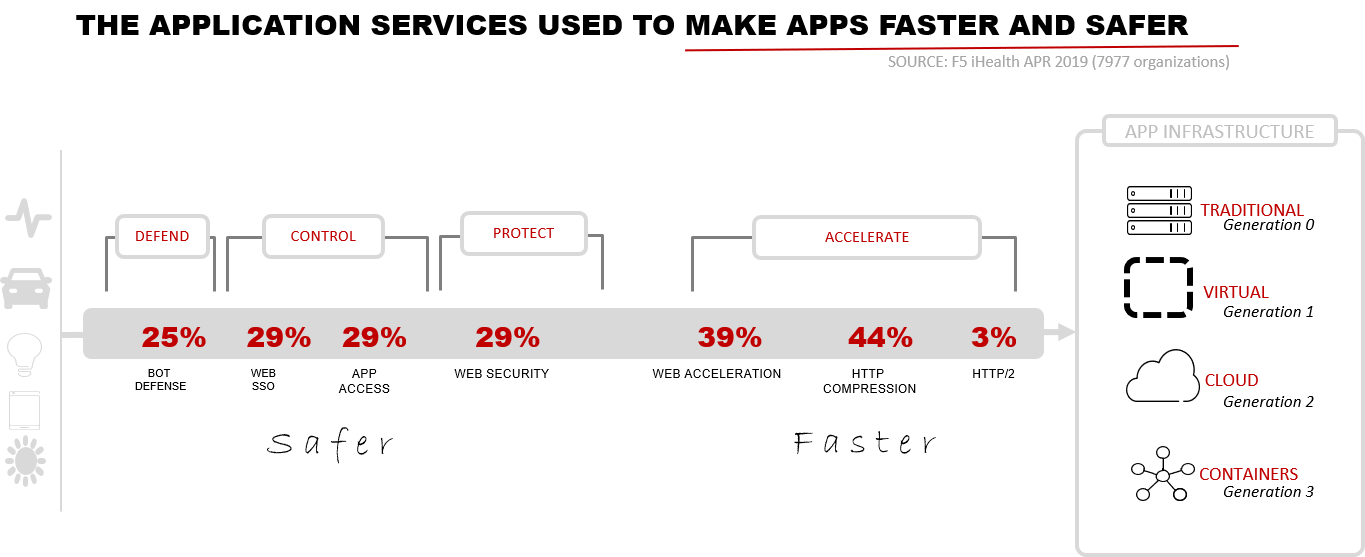
Of particular note was HTTP/2, which has held steady at a 2% usage rate since January 2018. This quarter saw the first increase to 3%. While still anemic compared to other acceleration techniques like compression and multiplexing, it is encouraging to see even a tiny improvement. HTTP/2 will be best put to use improving performance of traditional, chatty web applications. Modern, API-based apps like mobile and SPAs are less affected by protocol performance because their conversations are short. While they would still benefit, organizations are unlikely to see significant improvements in performance with HTTP/2 unless they're applying it to traditional, stateful web apps that reuse connections over the lifetime of a session.
DEFEND
BOT DEFENSE UP AGAIN
Bot defense gained 1% again over last quarter, growing from 24% to 25% of organizations employing it to defend against malicious non-human traffic.
Research from F5 Labs proposes that half of all Internet traffic originates with bots. Nearly one third (30%) of these are malicious.
CONTROL & PROTECT
SECURITY STANDS FIRM
Use of application access and web single-sign on services were steady quarter over quarter, while web security gained 1%.
Analysis from F5 Labs revealed that applications and identities were the initial targets in 86% of breaches, making these application services critical.
ACCELERATE
SPEED RETURNS
HTTP compression and caching services each made gains of 1% this quarter, rising from 43% to 44% and 28% to 29% respectively.
Interestingly, SSL offload (client side) and TCP multiplexing both saw 1% gains this quarter. Both app services put an emphasis on improving performance. It is also worth noting that the percentage of server-side SSL deployed (71%) is lower than that on the client-side (83%). While client-side SSL (83%) is often deployed both as a performance-enhancing measure and in response to consumer demand, server-side SSL is typically employed to satisfy regulatory demands and industry best practices.
About the Author

Lori MacVittie is a Distinguished Engineer and Chief Evangelist in F5’s Office of the CTO with deep expertise in application delivery, automation strategy, and infrastructure. She is known for turning complexity into clarity whether she’s defining guardrails for AI agents, dissecting brittle multicloud architectures, or probing the limits of scalable systems. She brings more than thirty years of industry experience across application development, IT architecture, and network and systems operations. Before joining F5, she served as an award-winning technology editor. MacVittie holds an M.S. in Computer Science and is a prolific author whose publications span security, cloud, and enterprise architecture. She is also an avid tabletop and video gamer with unapologetically strong opinions about cheese.
More blogs by Lori Mac VittieRelated Blog Posts

A new path to technical excellence for F5 partners
Introducing F5 Partner Foundations, a structured learning curriculum to build F5 partner engineer expertise with a clear pathway to specialization.

Secure-by-design storage for agentic AI: Why runtime visibility plus traffic control matters
Learn how F5 is collaborating with NVIDIA to help protect agentic AI with secure-by-design AI infrastructure, runtime visibility, and traffic control.

Why sub-optimal application delivery architecture costs more than you think
Discover the hidden performance, security, and operational costs of sub‑optimal application delivery—and how modern architectures address them.

Architecting for AI: Secure, scalable, multicloud
Operationalize AI-era multicloud with F5 and Equinix. Explore scalable solutions for secure data flows, uniform policies, and governance across dynamic cloud environments.

AppViewX + F5: Automating and orchestrating app delivery
As an F5 ADSP Select partner, AppViewX works with F5 to deliver a centralized orchestration solution to manage app services across distributed environments.

F5 NGINX Gateway Fabric is a certified solution for Red Hat OpenShift
F5 collaborates with Red Hat to deliver a solution that combines the high-performance app delivery of F5 NGINX with Red Hat OpenShift’s enterprise Kubernetes capabilities.