Back in 2015, I noted that Software was Eating IT. That was based on data culled from a variety of industry sources included RightScale, HBR, PWC, and others. From development to deployment to delivery, software was taking over everywhere.
But even then, the infiltration of software into the network – on the production side of the house – was still minimal. Oh, the signs were there and even many of the tools and APIs we needed. But if the breadth of the pipeline was a fancy meal, then development was the main course and deployment & delivery merely desert.
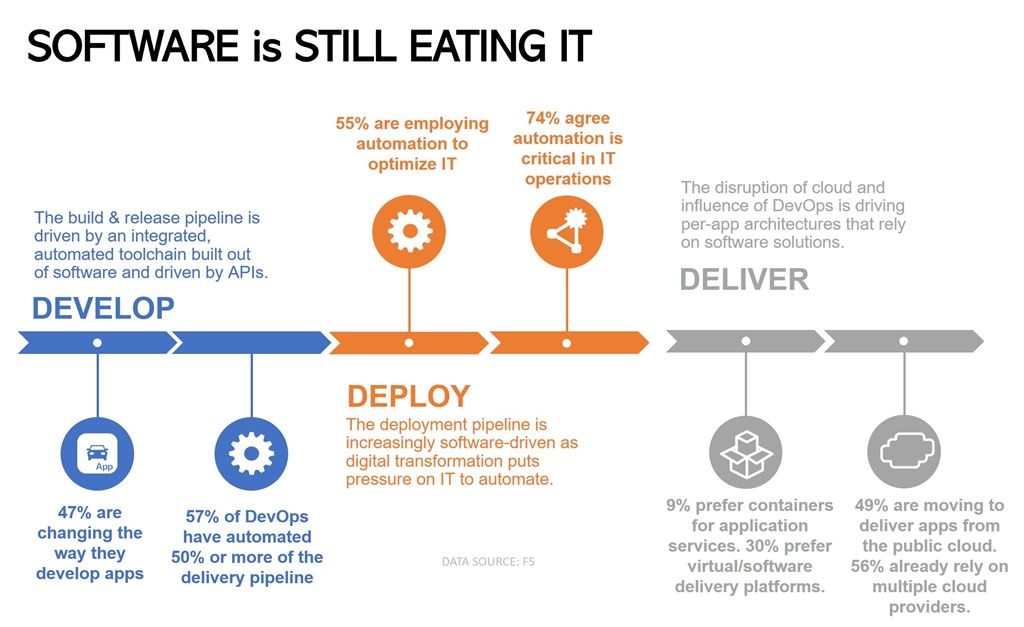
That was then, this is now. And what we’re seeing happen is that deployment & delivery is now one of three main courses in the application pipeline menu.
The data? Culled from F5 research over the past two years. Digital transformation is fingered as the driver of all this automation and change, but don't overlook the disruptive impact of public cloud in general.
Regardless of who gets the credit (or is it blame?) for the scales tipping in favor of software, it is nearly inarguable that software is still eating IT.
Development
The development segment of the application pipeline has always been driven by software. We used software to build the various libraries and executables. We used software to house versions of the code long before Git was a thing or CI/CD became a household* term.
What wasn’t always automated was the full breadth of the development segment. Automated testing and configuration management and event-driven build systems were not as common as they are today.
Thanks to cloud and DevOps, the development segment of the application pipeline has largely become a “software that builds the software” endeavor.
Deployment
Cloud and DevOps again get a head nod for driving the need for more automation in the deployment segment. This “other side of the production wall” segment is dominated by ops who automate app infrastructure deployment as well as they automate build and test processes. This was never really the problem. The issue was the “rest of the pipeline”. The piece of the pipeline that was comprised of network infrastructure providing the platforms for the application services necessary to scale, secure, and speed up apps.
It is this segment of the application pipeline that is now experiencing an explosive growth in automation by a growing group of savvy network engineers we’re calling NetOps, as a head nod to the DevOps movement that has (and continues to) influence the tools, techniques, and methodologies used to automate “the network.”
We see huge gains made in the past three years in terms of the use and importance of automation in network operations. The deployment segment of the application pipeline is on its way to becoming the “software that deploys the software” endeavor.
Delivery
The delivery segment of the application pipeline is set to the be the most disruptive of all. That’s partially because for twenty years our primary go-to in the network has been a shiny iron box. They scale, they have the capacity, and they’re faster than software, on the whole. But with the inevitability of multi-cloud organizations and the embrace of public cloud as an option for even the most critical of enterprise applications, the rules of the game have changed.
Hardware doesn’t migrate to the cloud. Hardware isn’t really the right platform to support the per-app architectures necessary to embrace immutable-infrastructure-as-code approaches to delivery. Software migrates to the cloud. Software supports per-app, immutability, and infrastructure as code.
The question isn’t really hardware or software (for the per-app, cloud architectures – the answer is obviously software) but is it containers or virtual software? With containers moving quickly to consume data centers and clouds alike, we’ve seen a doubling of demand for application services delivered in containers. Now, to be fair, that doubling was from about 4% in 2017 to 9% in 2018, but still that’s a significantly large jump whether it’s single-digit adoption or not.
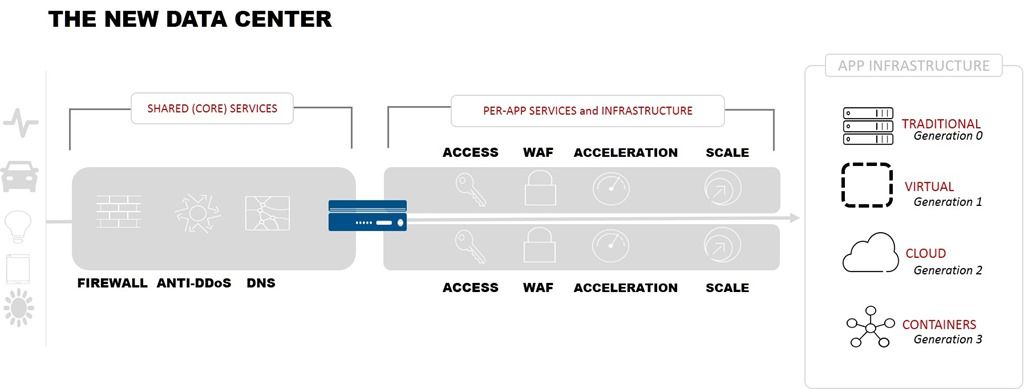
There’s also been a significantly higher demand for virtual software, with hardware preferences dropping year over year. Now, if you think it will ever drop to zero then you don’t really understand why we moved from software to hardware in the first place (yeah, we’ve been down this road before) and why some of the delivery segment (the core, shared network) will likely always be largely hardware in the enterprise.
The bulk of the delivery segment, however, will be software. Already is. Has been for a while. It’s the only way to ease the friction of migration to and from the public cloud and to address the growing friction of traditional deployment schedules with demand-driven app delivery schedules. Containers and virtual software will consume at least two-thirds of the application delivery segment – both on-premises and in the public cloud.
The delivery segment is becoming a “software delivering the software that delivers and secures software” endeavor.
That’s because software is still eating IT, and it’s going to continue to do so for the foreseeable future.
*If your household comprises mainly developers (which mine does) then CI/CD is a household term. YMMV.
About the Author

Lori MacVittie is a Distinguished Engineer and Chief Evangelist in F5’s Office of the CTO with deep expertise in application delivery, automation strategy, and infrastructure. She is known for turning complexity into clarity whether she’s defining guardrails for AI agents, dissecting brittle multicloud architectures, or probing the limits of scalable systems. She brings more than thirty years of industry experience across application development, IT architecture, and network and systems operations. Before joining F5, she served as an award-winning technology editor. MacVittie holds an M.S. in Computer Science and is a prolific author whose publications span security, cloud, and enterprise architecture. She is also an avid tabletop and video gamer with unapologetically strong opinions about cheese.
More blogs by Lori Mac VittieRelated Blog Posts
A new path to technical excellence for F5 partners
Introducing F5 Partner Foundations, a structured learning curriculum to build F5 partner engineer expertise with a clear pathway to specialization.
Secure-by-design storage for agentic AI: Why runtime visibility plus traffic control matters
Learn how F5 is collaborating with NVIDIA to help protect agentic AI with secure-by-design AI infrastructure, runtime visibility, and traffic control.
Why sub-optimal application delivery architecture costs more than you think
Discover the hidden performance, security, and operational costs of sub‑optimal application delivery—and how modern architectures address them.
Architecting for AI: Secure, scalable, multicloud
Operationalize AI-era multicloud with F5 and Equinix. Explore scalable solutions for secure data flows, uniform policies, and governance across dynamic cloud environments.
AppViewX + F5: Automating and orchestrating app delivery
As an F5 ADSP Select partner, AppViewX works with F5 to deliver a centralized orchestration solution to manage app services across distributed environments.

F5 NGINX Gateway Fabric is a certified solution for Red Hat OpenShift
F5 collaborates with Red Hat to deliver a solution that combines the high-performance app delivery of F5 NGINX with Red Hat OpenShift’s enterprise Kubernetes capabilities.