In days gone by, the app services delivering apps formed a straight and narrow data path. All apps basically traversed the same set of services over the same network. This architectural simplicity made it easy to combine a single point of control with a single point of execution. That, in turn, led to the rise of the application delivery controller (ADC). Through it, app traffic could be shaped, steered, scaled, and secured—all in one place. Control and execution combined to provide ops with a strategic point in the data path at which all manner of policies could be enforced and executed.
The rise of cloud and continued adoption of containers has disrupted that data path. We now have multiple and sometimes dynamic data paths through which apps are delivered. A single, strategic point of control and execution is often no longer operationally—or architecturally—feasible.
But that does not mean that a unified point of control is no longer possible even when execution is delegated to a disparate set of app services.
It is important to have as few points of control through which app services in the data path can be operated (deployed, configured, and managed). Encouraging the use of multiple control points inevitably results in conflicting policies that cause problems for app consumers. Troubleshooting issues becomes more complex and time consuming, which raises the ire and angst of users. Unfortunately, tool sprawl is a common complaint amongst those managing the addition of cloud-native architectures to an already diverse app portfolio.
We know from our 2020 State of App Services research that ops is primarily responsible for the operation of app services, but they aren't alone. DevOps, NetOps, and SecOps are all invested in the operation of app services both on-premises and in the public cloud.
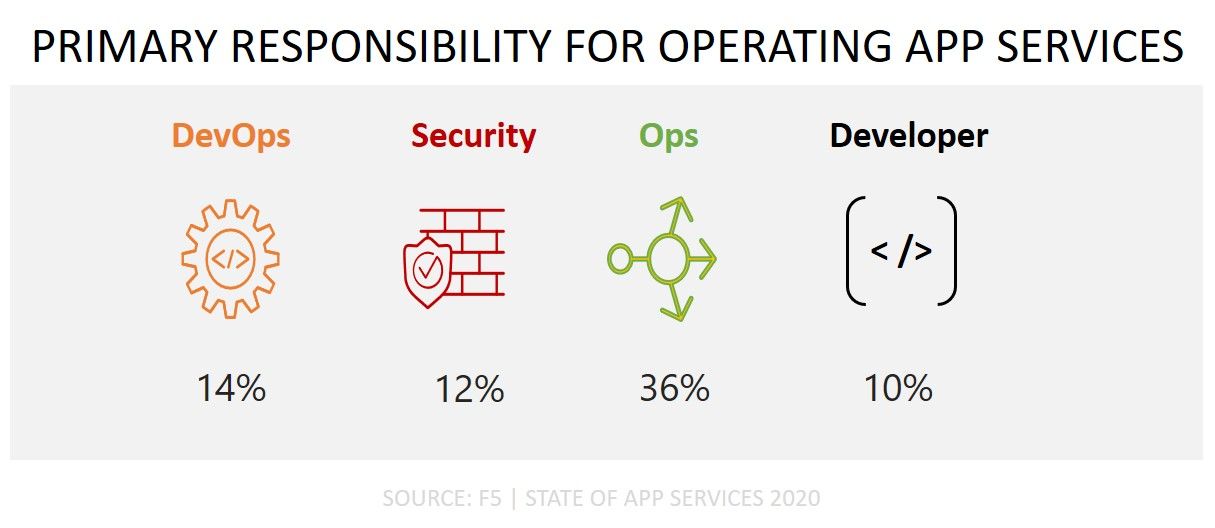
What often separates them is the specific functions of app services for which they are responsible.
DevOps are largely responsible for reliability, for performance, and for app-specific policies. NetOps, on the other hand, are, apropos of their moniker, more focused on network attributes. It is NetOps that often maintains app services from an infrastructure perspective. SecOps, of course, is concerned with security as it relates to the infrastructure and the app.
But just because there may be a division of duties does not mean there should be separate tools with which they practice their arts. Today, there is ample evidence that the CI/CD and continuous deployment pipelines are built on disparate toolsets. Jenkins and git repos dominate the CI/CD pipeline while Ansible and Python are the tools of choice on the continuous deployment side. Much of the decision lies in matching toolset to ways of working for the various constituents that must interact with the tools on a daily basis.
Thus, should a single tool emerge to improve policy consistency, speed troubleshooting, and eliminate the complexity and cost of tool sprawl, it must have the right interfaces to ensure that all major constituents of the app services in the data path are able to leverage the toolset to perform their respective duties.
That's important to the overall security and reliability of the app services themselves. By maintaining a unified point of control, organizations can be confident that changes are tracked and understood. While it's not an immutable implementation, it takes several steps toward that practice by centralizing control in a single tool.
An example of such a tool is NGINX Controller.
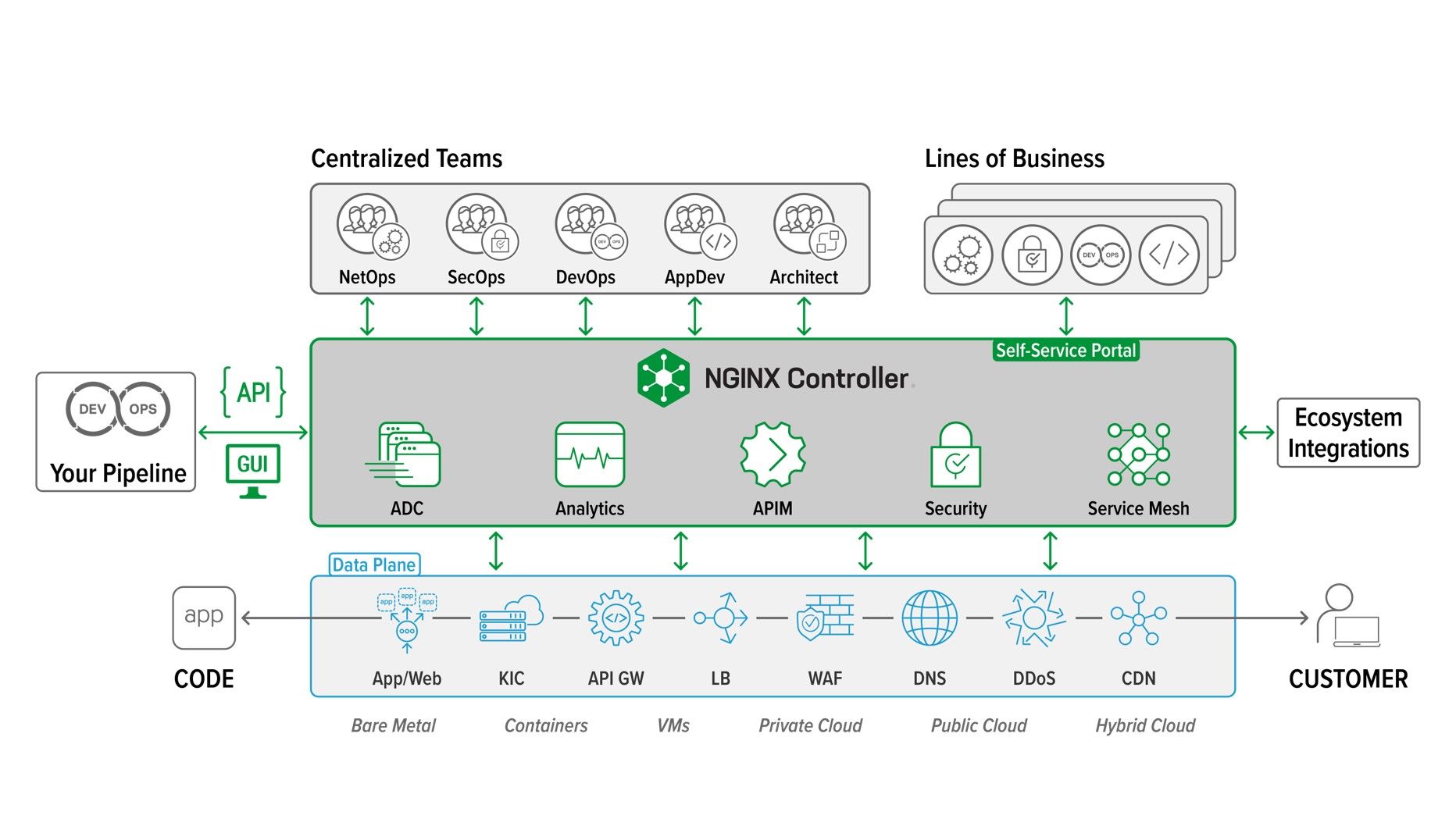
You'll note that, as envisioned, a variety of app services (analytics, API management, security, and service mesh) can all be controlled centrally, even though operation and execution are distributed.
In any environment, it's important to reduce the number of tools allowed to interact with data path components (app services) to mitigate potential problems with misconfiguration or conflicting configurations. In a modern, multi-cloud environment it's even more critical to centralize control because of the complexity incurred by the often exponential growth of app services comprising the data path.
More compelling to those who own the budgets is the reduction of operational expense associated with eliminating repetitive, manual activities with automation.
Unifying control in a single tool is one way to do that.
About the Author

Lori MacVittie is a Distinguished Engineer and Chief Evangelist in F5’s Office of the CTO with deep expertise in application delivery, automation strategy, and infrastructure. She is known for turning complexity into clarity whether she’s defining guardrails for AI agents, dissecting brittle multicloud architectures, or probing the limits of scalable systems. She brings more than thirty years of industry experience across application development, IT architecture, and network and systems operations. Before joining F5, she served as an award-winning technology editor. MacVittie holds an M.S. in Computer Science and is a prolific author whose publications span security, cloud, and enterprise architecture. She is also an avid tabletop and video gamer with unapologetically strong opinions about cheese.
More blogs by Lori Mac VittieRelated Blog Posts

A new path to technical excellence for F5 partners
Introducing F5 Partner Foundations, a structured learning curriculum to build F5 partner engineer expertise with a clear pathway to specialization.
Secure-by-design storage for agentic AI: Why runtime visibility plus traffic control matters
Learn how F5 is collaborating with NVIDIA to help protect agentic AI with secure-by-design AI infrastructure, runtime visibility, and traffic control.
Why sub-optimal application delivery architecture costs more than you think
Discover the hidden performance, security, and operational costs of sub‑optimal application delivery—and how modern architectures address them.
Architecting for AI: Secure, scalable, multicloud
Operationalize AI-era multicloud with F5 and Equinix. Explore scalable solutions for secure data flows, uniform policies, and governance across dynamic cloud environments.
AppViewX + F5: Automating and orchestrating app delivery
As an F5 ADSP Select partner, AppViewX works with F5 to deliver a centralized orchestration solution to manage app services across distributed environments.

F5 NGINX Gateway Fabric is a certified solution for Red Hat OpenShift
F5 collaborates with Red Hat to deliver a solution that combines the high-performance app delivery of F5 NGINX with Red Hat OpenShift’s enterprise Kubernetes capabilities.