Opinionated collection of data leads to missing data, which means you’re going to miss insights.
The results are in. Every year we survey the market on a wide variety of technology and business trends and topics. And every year we are surprised by some responses. One response we were not surprised by was the pervasiveness of missing insights. Out of more than 1400 respondents, nearly everyone – 98% – report they are missing insights. Unchanged are the nature of those insights: root cause of performance degradation, root cause of incidents, and indication of a possible attack. Performance. Availability. Security. The “big three” concerns of IT when operating a digital business continue to drive a need for more data.
The impact of those missing insights is troubling. It is no longer merely just a problem for IT professionals held accountable for meeting SLAs related to performance, availability, and security. Outages, issues, and security incidents have a very real and negative impact on a digital business.
Some effects are obvious. Loss of reputation and revenue, decreased productivity, damaged relationships with partners. Others are not so obvious, such as the loss of unrealized opportunities that might have otherwise been uncovered through analysis of data across operational and business lines.
But knowing insights are missing is just half the battle. No one is surprised by this today. Growth of digital business leads to scale and expansion of the systems, services, and environments required to support demand. With so many distributed components across multiple clouds and, now, the edge, it’s no surprise that missing data was cited as the most common challenge faced in the quest to find those missing insights.
This is, in part, the cost of data bias: the opinionated collection of data.
“The cost of deploying—and managing—agents introduced data bias because it limited the systems from which you could collect data. Opinions—experienced or not—regarding the worthiness of monitoring a given application or system often drove the deployment decision.” – Most Missing Insights are Due to Data Bias
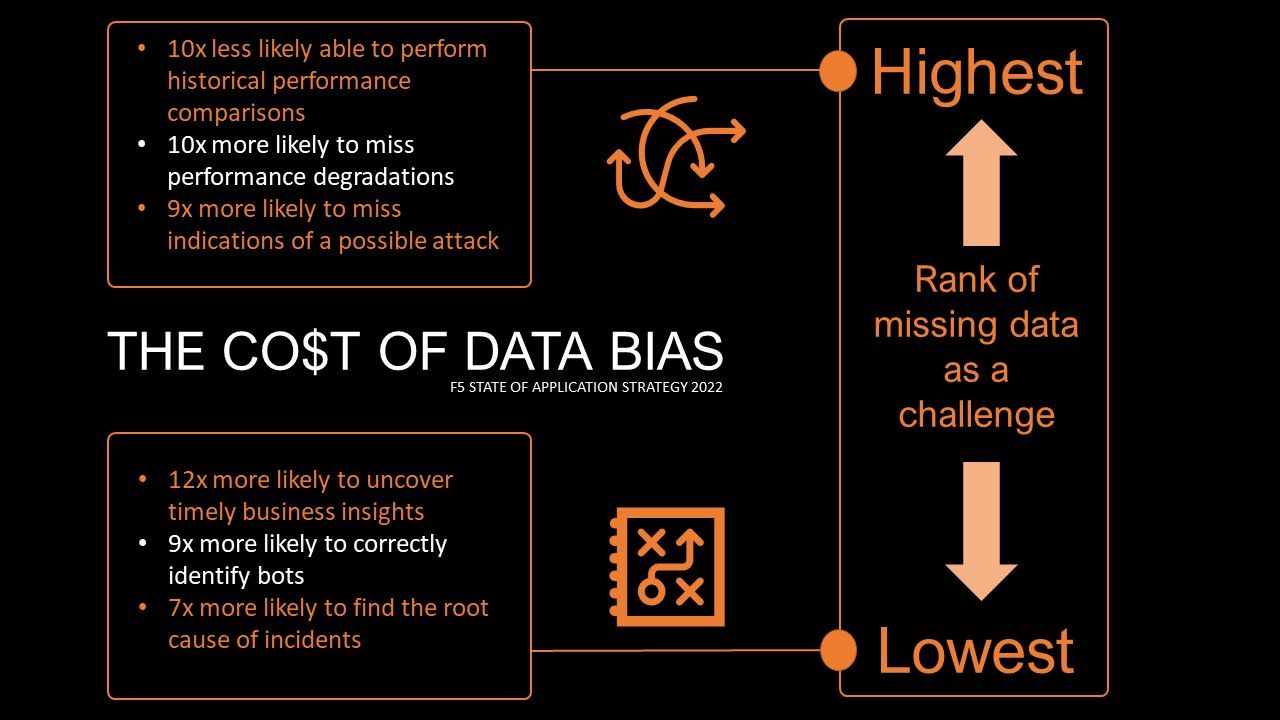
Those that have surmounted the challenge of missing data are well-positioned to take advantage of the insights analysis that data can unlock. These organizations are twelve times more likely to uncover timely business insights that lead to tangible benefits like an increase in revenue per user.
They are also more likely to correctly identify bots, which in turn means they are less likely to fall victim of bots that exploit digital channels and can wreak havoc on the business itself.
What we can’t quantify yet is the impact of “false” insights caused by missing data to the business. We know that misclassification—false positives—of legitimate users as bots is a problem, one that often leads organizations to forgo active security to avoid potentially blocking a revenue-generating user. The Aite Group estimated that losses to false positives would far exceed projected fraud loss of $6.4B.
And the impact goes beyond revenue to other business outcomes such as customer acquisition cost and lifetime value. It is not unthinkable that similar “false positives” might arise in the future with respect to business insights.
That’s why it’s so important to develop a data and observability strategy before you begin relying on insights to operate your digital business.
We are on the cusp of a digital as default world, in which every business is a digital business. Digital business runs on data, which means developing a data and observability strategy is critical to future success. Without a strategy the insights—and subsequent decisions—made on data may very well be the wrong ones.
____
Interested in learning more about the latest ideas and innovations around security, development, and infrastructure for adaptive applications? Register for F5's Agility 2022 virtual event on February 15-16.
About the Author

Lori MacVittie is a Distinguished Engineer and Chief Evangelist in F5’s Office of the CTO with deep expertise in application delivery, automation strategy, and infrastructure. She is known for turning complexity into clarity whether she’s defining guardrails for AI agents, dissecting brittle multicloud architectures, or probing the limits of scalable systems. She brings more than thirty years of industry experience across application development, IT architecture, and network and systems operations. Before joining F5, she served as an award-winning technology editor. MacVittie holds an M.S. in Computer Science and is a prolific author whose publications span security, cloud, and enterprise architecture. She is also an avid tabletop and video gamer with unapologetically strong opinions about cheese.
More blogs by Lori Mac VittieRelated Blog Posts

Multicloud chaos ends at the Equinix Edge with F5 Distributed Cloud CE
Simplify multicloud security with Equinix and F5 Distributed Cloud CE. Centralize your perimeter, reduce costs, and enhance performance with edge-driven WAAP.

At the Intersection of Operational Data and Generative AI
Help your organization understand the impact of generative AI (GenAI) on its operational data practices, and learn how to better align GenAI technology adoption timelines with existing budgets, practices, and cultures.
Using AI for IT Automation Security
Learn how artificial intelligence and machine learning aid in mitigating cybersecurity threats to your IT automation processes.
Most Exciting Tech Trend in 2022: IT/OT Convergence
The line between operation and digital systems continues to blur as homes and businesses increase their reliance on connected devices, accelerating the convergence of IT and OT. While this trend of integration brings excitement, it also presents its own challenges and concerns to be considered.
Adaptive Applications are Data-Driven
There's a big difference between knowing something's wrong and knowing what to do about it. Only after monitoring the right elements can we discern the health of a user experience, deriving from the analysis of those measurements the relationships and patterns that can be inferred. Ultimately, the automation that will give rise to truly adaptive applications is based on measurements and our understanding of them.
Inserting App Services into Shifting App Architectures
Application architectures have evolved several times since the early days of computing, and it is no longer optimal to rely solely on a single, known data path to insert application services. Furthermore, because many of the emerging data paths are not as suitable for a proxy-based platform, we must look to the other potential points of insertion possible to scale and secure modern applications.