Scalable AI
AI systems that continue to perform reliably as datasets, models, user populations, and workloads grow.
Scalable AI refers to the ability of AI systems, models, data pipelines, infrastructure, and operations to maintain performance, reliability, and cost efficiency as demand and complexity increase. It’s the difference between an AI pilot that works in a lab and an AI capability that serves real-world enterprise workloads at scale.
What is scalable AI?
Scalable AI creates systems that expand to manage more data, more users, larger models, and distributed locations, without performance loss or high costs. True scalability requires synchronized growth across the entire AI stack, including data pipelines, models, GPU clusters, networks, inference, and operations.
A model that works in development often stalls at production scale: data pipelines aren’t ready, inference endpoints struggle under concurrency, or networking becomes the bottleneck instead of compute.
Scalability shows up in several core dimensions:
- Data scaling: Moving from one-off datasets to real-time, high-throughput pipelines
- Model scaling: Expanding from a single model to many models and variants deployed across regions
- Infrastructure scaling: Ensuring GPU/CPU, storage, and networking keep pace with growth
- Operational scaling: Maturing release processes, observability, traffic engineering, and cost management
When implemented effectively, scalable AI delivers reliable, consistent performance as workloads grow. This transformation turns AI from pilot experiments into robust, enterprise-wide capabilities. By establishing a solid foundation for traffic management, security, and visibility, areas where F5 is specifically focused, businesses can confidently and rapidly scale AI without risking system instability or accumulating hidden operational debt.
Why is scalable AI important?
Without scalability, AI efforts quickly reach a limit. Organizations can create proofs of concept (POCs), but scaling to support thousands or millions of requests daily is a different challenge.
Scalable AI is key to address because:
- Business demand exceeds initial architectures, and AI integration accelerates traffic growth unpredictably. Most AI deployments begin with a single model, workflow, and team. After demonstrating value, adoption spreads across units, causing traffic spikes as new applications connect to shared endpoints. Systems initially designed to handle thousands of requests per hour now handle millions per day. Without scalable networking, this rapid growth can overwhelm infrastructure.
- AI systems can fail subtly at scale, leading to latency spikes, GPU underutilization, model overload, or data pipeline stalls that undermine reliability. AI failures rarely cause major outages; they usually result in degraded performance. GPUs often sit idle, inference queues back up under high load, or latency spikes during peak times. A misrouted traffic pattern or slow data shard can disrupt the entire pipeline. These systemic issues typically appear under real load, making them hard to diagnose without proper observability and traffic management intelligence.
- Operational costs rise rapidly due to inefficient inference paths, unmanaged concurrency, and poorly shaped traffic, which can double or triple cloud expenses. Inference costs rise due to poor traffic management, unbatched requests, uneven load, cold GPU paths, or misaligned routing, leading to unnecessary scaling and overprovisioning. Cloud GPUs are costly; without proper management, teams end up paying for idle GPUs or excess replicas. Many enterprises find that networking issues, not model complexity, drive inference costs and expenses.
- Compliance and governance need enterprise tools. Production AI requires guardrails that pilots don’t. Early AI pilots often lack formal controls like API security, model lineage tracking, and data governance. But with AI handling customer data, regulated workflows, or sensitive content, organizations must ensure safeguards such as policy enforcement, audit trails, access controls, encryption, and version management. These are essential for deploying AI in finance, healthcare, government, or global businesses.
- Competitive advantage increases as scale grows. Faster inference, more model iterations, and improved user experiences lead to lasting differentiation. Scalability safeguards the system and boosts innovation. Teams that quickly retrain models, deploy updates, or deliver low-latency inference gain competitive edges. Users see better responsiveness, features are released faster, and models are refined more often. This operational speed creates a moat that competitors struggle to beat.
Scalable AI enables an enterprise to grow its use cases with confidence, whether by supporting increased users, implementing more complex models, or deploying AI across various regions and cloud platforms.
How does scalable AI work?
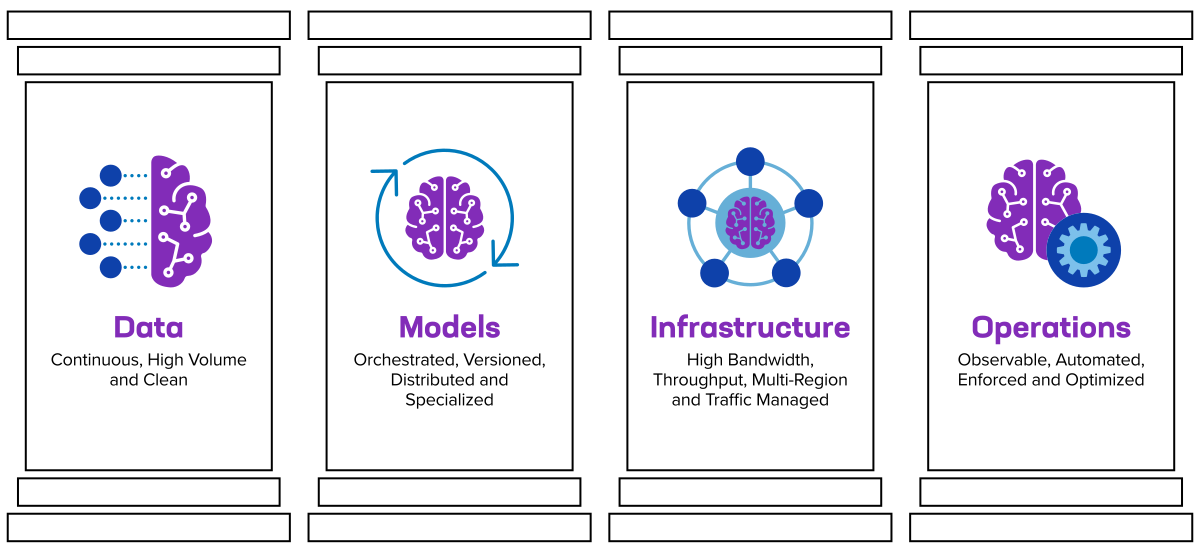
Scalable AI works by coordinating four growth pillars: data, models, infrastructure, and operations. All four must be aligned. If even one lags, the entire system becomes constrained.
1. Scaling data
Data often acts as the first bottleneck. AI systems need continuous, clean, high-volume data pipelines to support training and inference without overloading GPUs or disrupting workflows, even as data volume grows.
- Continuous data ingestion: AI pipelines must reliably and securely pull real-time data from multiple sources to ensure models use fresh, accurate inputs.
- High-throughput data pipelines: Systems must deliver data quickly to keep GPUs fully utilized and avoid idle cycles from slow or inconsistent input streams.
- Feature stores and vector databases: These systems standardize, store, and serve features or embeddings at scale, ensuring reproducibility and low-latency inference.
- Data quality and consistency controls: Clean, validated, lineage-aware data reduces model drift, prevents pipeline failures, and increases confidence in model outputs.
- Scalable storage systems: Underlying storage must grow with the dataset, enabling parallel access, fast retrieval, and predictable performance as volume increases.
2. Scaling models
Enterprises rapidly transition from a single model to hundreds, including distilled versions, task-specific variants, and fine-tuned models. Model scalability means more than just increasing model parameters; it includes:
- Multi-model orchestration: Coordinating multiple models ensures the right one runs at the right time without overloading the endpoint.
- Versioning, rollouts, and rollbacks: Managing model versions with controlled rollouts and instant rollbacks prevents outages and enables safe, continuous improvement.
- Distributed inference: Running inference across nodes or regions reduces latency and balances load, preventing bottlenecks in any single GPU or cluster.
- Model specialization by region or use case: Deploying tailored variants for different markets or tasks enhances performance and efficiency by matching each model to its optimal context.
3. Scaling infrastructure
AI workloads require high-performance compute, storage, and networking. As usage grows, organizations must scale GPU capacity and:
- High-bandwidth networking: Networking must deliver low-latency, high-throughput paths so GPUs stay fed with data instead of stalling on congested links.
- High-throughput storage: Storage systems need to provide continuous, parallel access to massive datasets to prevent I/O bottlenecks during training and inference.
- Multi-region deployment: Distributing infrastructure across regions improves resilience and reduces latency by placing compute and models closer to users and data sources
- Traffic steering and load balancing at line rate: Intelligent, high-speed traffic routing ensures inference requests are evenly distributed, keeping GPU clusters fully utilized and preventing hotspots.
Infrastructure needs to remain efficient because GPU capacity is costly, and inefficient traffic routing results in waste.
4. Scaling operations
Even the most robust hardware can’t make up for weak operations. Enterprise AI demands:
- Observability for latency, throughput, cost per inference: Teams need real-time insights into model and infrastructure behavior to detect bottlenecks, tune performance, and prevent silent failures.
- Incident response for model degradation: When accuracy drops or latency spikes, organizations must diagnose root causes quickly and restore stable service without disrupting users.
- Automated pipelines for deployment: Reliable automation ensures model updates transfer safely from development to production without the risk of manual steps.
- Policy enforcement and governance: Strong controls are necessary to protect model endpoints, enforce access rules, and ensure compliance in complex AI environments
- Cost visibility and optimization: Monitoring GPU usage, inference, and routing efficiency helps teams control costs and avoid unnecessary scaling events.
How does F5 address core dimensions of scalable AI?
F5 considers scalable AI through the lens of the core challenges enterprises face in traffic engineering, security, and visibility. These layers often become the bottleneck as AI workloads expand, even in organizations equipped with abundant GPUs and advanced model architectures.
F5 helps enterprises scale AI by:
- Maximizing GPU utilization through intelligent traffic routing: AI inferencing throughput varies with request distribution. F5 BIG-IP Local Traffic Manager (LTM) provides load balancing, model-aware routing, and latency-optimized traffic paths, keeping GPU clusters saturated and efficient rather than waiting on slow or uneven request flows.
- Eliminating network bottlenecks: High-concurrency inference can overwhelm traditional networking stacks well before compute reaches capacity. F5 BIG-IP Platform and F5 Distributed Cloud App Connect manage extreme bandwidth situations and reduce congestion, ensuring inference traffic flows smoothly to all endpoints.
- Securing inference endpoints and model APIs: AI services depend on APIs that need true application L7 protection, not just packet filtering. F5 BIG-IP Advanced WAF, F5 Distributed Cloud Web App and API Protection (WAAP), and F5 BIG-IP SSL Orchestrator offer deep inspection (including encrypted traffic), policy enforcement, bot and abuse prevention, and runtime protections to protect sensitive models and inference routes.
- Providing visibility across hybrid AI environments: AI traffic occurs across various environments, often with unclear, inconsistent patterns. F5 Distributed Cloud App Stack, along with the BIG-IP telemetry streaming function, provides teams with real-time data on latency, throughput, model endpoint performance, queue depth, and API health, enabling operators to optimize performance and resolve problems before they affect users.
- Supporting modern, S3-compatible and high-throughput data pipelines: For data-intensive AI training and ingest pipelines, BIG-IP speeds up high-volume traffic to S3-compatible object storage. With partners like NetApp StorageGRID, F5 ensures data pipelines scale smoothly with model training and retrieval workloads.
F5 traffic, security, and visibility layers, provided via BIG-IP and Distributed Cloud Services, are designed to ensure AI workloads remain reliable, efficient, and high-performing amid growing demand.
Why scalability matters early in development
AI systems today develop faster than the infrastructure that supports them. Models grow, use cases expand in scope, and concurrency increases as organizations integrate AI into products, workflows, and customer experiences. Meanwhile, cost expectations become stricter, and governance requirements raise the standards for operational discipline.
Scalability is not just about optimization; it’s a fundamental requirement for making AI reliable and repeatable across an organization. Without a solid, scalable base, each new AI application risks being a custom project with inconsistent performance and rising costs.
Enterprises that invest early in scalable AI infrastructure as the operational backbone of their AI gain:
- Faster iteration cycles
- Lower operating costs
- More consistent performance
- Higher reliability and security
- A sustainable path for enterprise-wide adoption
Architecture and infrastructure for scalable AI
AI scalability relies on infrastructure capable of matching workload demands. Enterprises usually consider four architectural options: cloud, on-premises, hybrid, and edge.
- Cloud-based AI scalability: Cloud speeds up experimentation and capacity but faces costs and latency issues at scale. Constraints include traffic engineering, GPU availability, and performance predictability.
- On-premises AI scalability: On-premises options offer predictable costs, strict data governance, and stable performance but need careful planning for power, cooling, and networking, especially for dense GPU clusters.
- Hybrid AI architectures: Most enterprises operate in this space, with training often in the cloud, inference at the edge, and fine-tuning on a dedicated GPU cluster. Scalability relies on dependable networking, routing, and security across different environments.
- Edge AI scalability: Edge inference lowers costs and latency but necessitates model distillation, replication approaches, and effective traffic management between edge devices and the cloud.
Key technologies that enable scalable AI:
- Containers and orchestration
- Vector databases and feature stores
- Distributed training frameworks
- CI/CD for ML (MLOps pipelines)
- Model registries and versioning
- Traffic management and L7 routing
- S3-compatible object storage pipelines
Networking is central to scalable AI, as dense GPU clusters produce high east-west traffic, and inference tasks require resilience, low latency, and smart routing. F5 capabilities are fundamental in this context.
Best practices for scaling AI models
Scaling AI models is fundamentally about service design, not solely about model tuning. To provide dependable and cost-effective inference, organizations need to synchronize their architecture and operational processes.
- Design stateless, horizontally scalable services: Separate model runtime from state, and ensure endpoints can automatically scale with traffic.
- Use batching, caching, and split data into manageable chunks (sharding): These reduce GPU pressure and smooth concurrency spikes. Many organizations achieve substantial cost reductions by consistently applying these patterns.
- Manage model versions with discipline: Rollouts, A/B tests, and rollbacks must be quick and secure. Poor versioning remains one of the leading causes of inference incidents.
- Monitor first-class metrics: Latency, throughput, cost-per-inference, GPU utilization, timeout rates, and queue depth should all be monitored in real-time visibility.
- Address data immaturity early: Data quality problems, such as siloed pipelines, incorrect labels, and missing lineage, become persistent obstacles as scale increases. Investing in data readiness often provides greater benefits than simply expanding data infrastructure GPUs.
- Integrate model-aware routing: AI traffic patterns are not consistent. Routing by model type, size, queue depth, or user region greatly enhances performance and efficiency.
Challenges in implementing scalable AI
Scaling AI introduces challenges across technology, organization, and cost.
- Technical bottlenecks include fragmented infrastructure, underpowered or misconfigured networks, storage systems unable to support GPUs, and latency-sensitive inference endpoints experiencing load issues.
- Organizational gaps comprise siloed AI and infrastructure teams, poor MLOps maturity, and a lack of ownership and accountability for production AI.
- Cost and capacity constraints include GPU scarcity, unpredictable inference traffic, cloud cost spikes, and inefficient routing that lowers GPU utilization.
- Security and governance are critical. Sensitive model assets require isolation, encrypted traffic (which obscures threats) must be examined, API access must be managed consistently, and real-time visibility is essential to detect model drift and misuse.
This is where F5 offers an advantage by eliminating networking bottlenecks, securing traffic and APIs, and providing visibility that enables teams to scale AI confidently instead of relying on makeshift solutions.
Scalable AI | FAQ
What is scalable AI in practical terms?
AI that maintains reliable performance as demand, data, and model complexity increase.
How is scalability different from adding GPUs?
Achieving true scalability depends on synchronized growth across data pipelines, networks, operations, and model architectures, not merely on isolated hardware improvements.
What factors influence AI scalability?
Data readiness, model architecture, networking capacity, GPU utilization, concurrency management, and governance are all key elements to focus on.
How should organizations think about cloud vs on-premises?
Cloud accelerates experimentation, while on-premises enhances predictability and governance. As a result, most enterprises typically adopt a hybrid approach.
What leads AI pilots to stall before scaling to production?
Common causes include data immaturity, limited networking, underused GPUs, inefficient routing, weak operational processes, and unclear ownership.
How does networking impact scalable inference?
Latency, throughput, and GPU utilization are affected by routing, managing concurrency, and traffic engineering.
Where should teams start?
Focus on visibility. Identify current constraints such as networking, data, and GPU saturation, then develop a roadmap based on these bottlenecks.
How F5 helps
Scalable AI forms the basis for effective enterprise AI. It requires integrated data pipelines, robust model architectures, high-performance infrastructure, reliable networking, solid governance, and disciplined operations. Organizations that invest now can confidently and cost-effectively expand AI applications without compromising performance or security.
Learn more how the F5 Application Delivery and Security Platform helps organizations scale their AI initiatives at f5.com/solutions/ai-delivery-and-security.