So says data from the most recent Continuous Intelligence Report from Sumo Logic
Most enterprise organizations are multi-cloud. So says our own research, as well as just about every other industry report I can find. In fact, I find consistently that less than 20% of organizations are shunning public cloud in general. Given the nearly ubiquitous use of SaaS to supply commoditized business functions (CRM, productivity, SFA, communications) it seems inarguable that organizations make use of multiple cloud properties to host a portion of their application portfolios.
Digging through Sumo Logic's latest data - compiled from actual usage of more than 2000 customers - we see an increase in Kubernetes usage specifically in AWS. In 2018, 20% of AWS customers used ECS (Amazon's container service). That grew to 22% in 2019. By comparison, in 2018 only 14% of AWS customers were using Kubernetes. In 2019 that percentage grew to 20%.
It is not surprising to discover that when we start looking at customers using more than one (multiple) cloud properties, Kubernetes clearly leaps ahead of cloud-provider offerings.
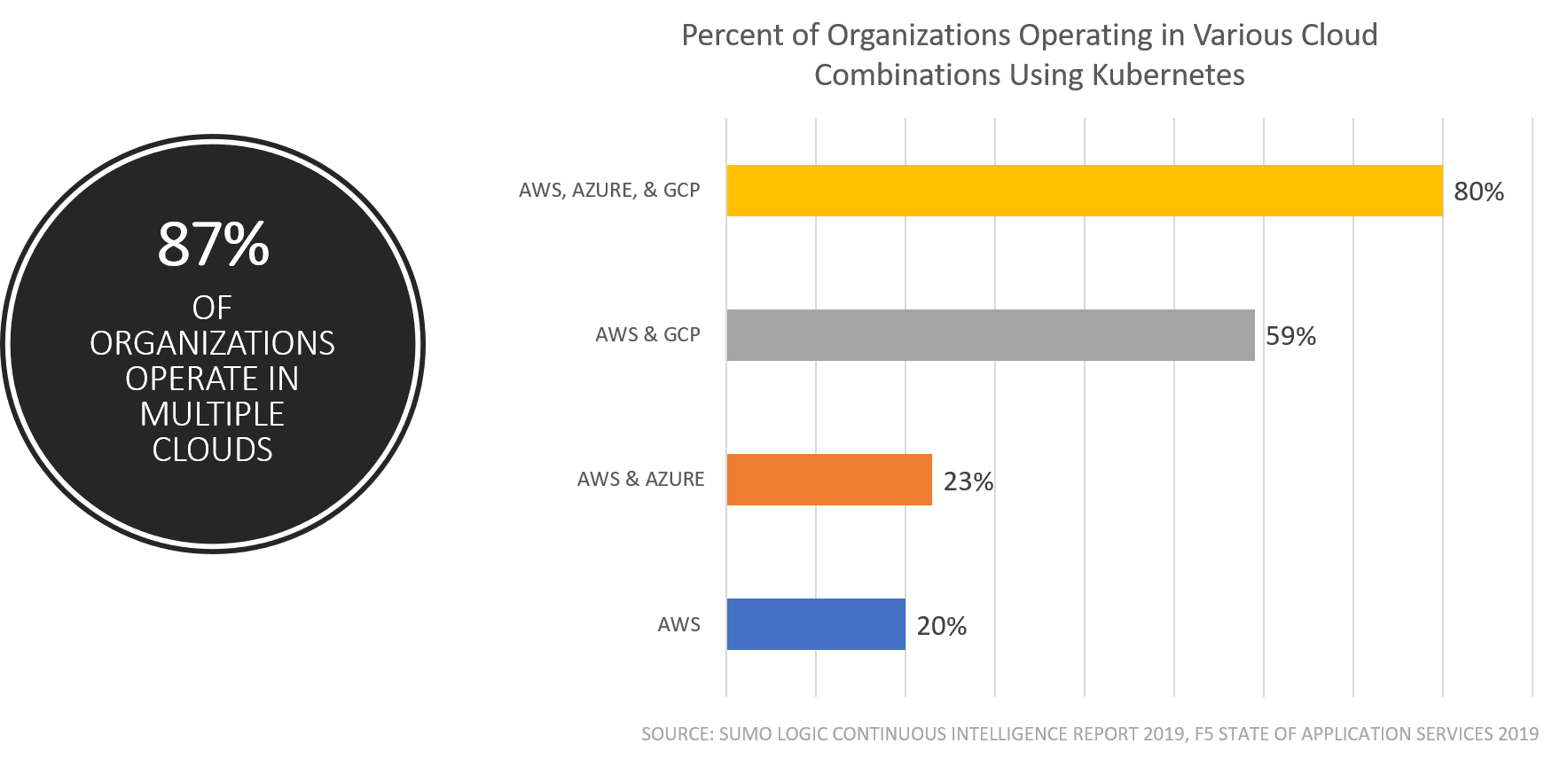
I say unsurprising because when you ask customers why they're adopting a multi-cloud approach, one of the top answers is always "avoid vendor lock-in." That's been a reason for multi-vendor everything in the enterprise for twenty and more years. It should surprise no one that holds true for public cloud, as well. After all, cloud is a product as surely as a network switch or data center server.
This central theme combines well with an oft-cited driver for Kubernetes adoption: portability.
Enterprises are clearly seeking a path that allows them the freedom to deploy applications in multiple environments without becoming locked into those environments (a.k.a. portability). Consider this finding from Heptio’s State of Kubernetes on the relationship between Kubernetes and lock-in:
Organizations with open source Kubernetes in production are more motivated to avoid lock-in (66% vs average 60%) and to enable multi-cloud (56% versus average of 48%).
And this nugget, too, from Portworx and Aqua Security’s 2019 Container Adoption Survey in which 19% of respondents are running apps in containers specifically to “enable users to run on multiple-cloud platforms.”
This desire for multi-cloud/portability to avoid lock-in is likely why we see a dearth of adoption of cloud specific application services in the Sumo Logic report and the understandable correlation between Kubernetes and multi-cloud adoption.
Granted, Sumo Logic is focusing only on AWS usage with respect to application services. That's primarily because the bulk (64%) of the Sumo Logic customer base resides in an Amazon cloud. But that means the data is solid when it comes to AWS. We can postulate - and probably correctly - that the same holds true for other cloud providers, as well. Because the driving factors behind the data remain true no matter the cloud.
That data shows that of the more than 150 application services offered by Amazon, the median adopted is 15. That's fewer than 10% of all services offered. In the top ten are those you would expect: compute, storage, database, network, and identity services. Core infrastructure.
Sumo Logic notes that "management, tooling, and advanced security services are adopted at a significantly lower rate than core infrastructure services."
I would submit that the continuing challenge of consistency - which tops our multi-cloud challenge list every year - is a key factor in the reluctance to adopt cloud-specific management, tooling, and advanced security services. Container orchestration falls into that "tooling" category and loosely into "management" as well. So, it's no surprise that organizations seeking consistency and actively avoiding lock-in are flocking to the more portable Kubernetes.
There are other valuable nuggets in the Sumo Logic report - including app infrastructure and security services usage in AWS, as well as some unsurprising data about Lambda adoption - so I encourage you to check it out. It's light on commentary and big on data, which makes it an easy and informative read.
About the Author

Lori MacVittie is a Distinguished Engineer and Chief Evangelist in F5’s Office of the CTO with deep expertise in application delivery, automation strategy, and infrastructure. She is known for turning complexity into clarity whether she’s defining guardrails for AI agents, dissecting brittle multicloud architectures, or probing the limits of scalable systems. She brings more than thirty years of industry experience across application development, IT architecture, and network and systems operations. Before joining F5, she served as an award-winning technology editor. MacVittie holds an M.S. in Computer Science and is a prolific author whose publications span security, cloud, and enterprise architecture. She is also an avid tabletop and video gamer with unapologetically strong opinions about cheese.
More blogs by Lori Mac VittieRelated Blog Posts

A new path to technical excellence for F5 partners
Introducing F5 Partner Foundations, a structured learning curriculum to build F5 partner engineer expertise with a clear pathway to specialization.
Secure-by-design storage for agentic AI: Why runtime visibility plus traffic control matters
Learn how F5 is collaborating with NVIDIA to help protect agentic AI with secure-by-design AI infrastructure, runtime visibility, and traffic control.

Why sub-optimal application delivery architecture costs more than you think
Discover the hidden performance, security, and operational costs of sub‑optimal application delivery—and how modern architectures address them.
Architecting for AI: Secure, scalable, multicloud
Operationalize AI-era multicloud with F5 and Equinix. Explore scalable solutions for secure data flows, uniform policies, and governance across dynamic cloud environments.
AppViewX + F5: Automating and orchestrating app delivery
As an F5 ADSP Select partner, AppViewX works with F5 to deliver a centralized orchestration solution to manage app services across distributed environments.

F5 NGINX Gateway Fabric is a certified solution for Red Hat OpenShift
F5 collaborates with Red Hat to deliver a solution that combines the high-performance app delivery of F5 NGINX with Red Hat OpenShift’s enterprise Kubernetes capabilities.